Project Tour : Autodesk Construction Cloud
Building a content architecture for 18+ products, and the governance to hold it together.
In 2020, Autodesk made a significant investment in construction technology. Through a series of acquisitions including PlanGrid, BuildingConnected, and Assemble, there was now a powerful ecosystem of AEC tools. The challenge was that each product had its own identity, its own language, and its own web presence. Individually they were strong. Together they were incoherent.
Autodesk Construction Cloud was the brand that would unify them. My job was to build the content infrastructure to make that unity real for the people who needed these tools most: contractors, project managers, owners, and the AEC teams who depend on connected workflows to get buildings built.
The Problem
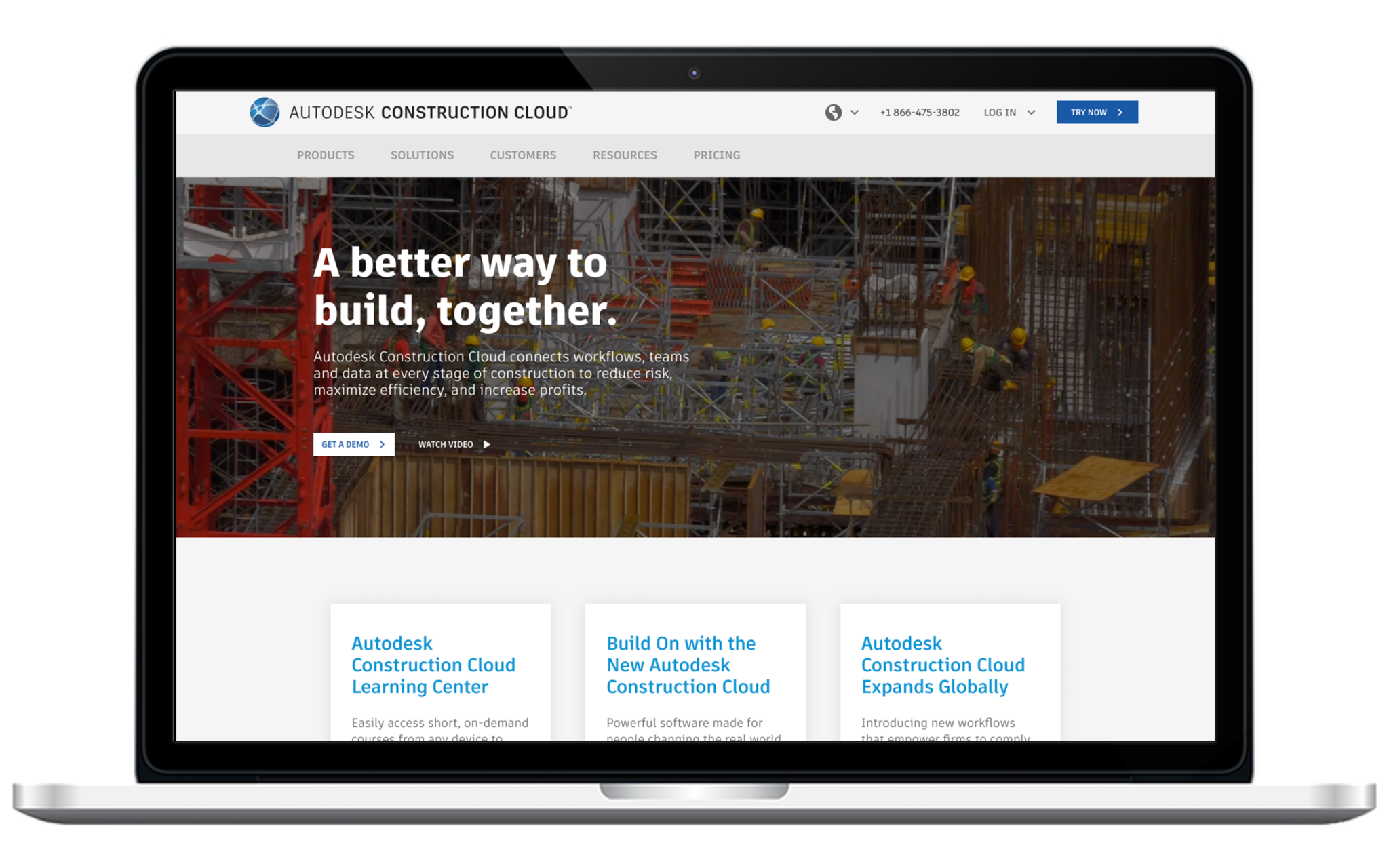
When I came in as Lead Digital Strategist, construction.autodesk.com didn't include products, capabilities and features from acquired companies. There was no common architecture to bring all the disparate product information into a single experience and help prospects understand how the products worked together, or help existing customers discover what else was available to them.
The content challenges were structural:
No shared information architecture. Each product page was organized differently. A prospect trying to understand how Autodesk Build, Takeoff, and BuildingConnected fit together had to reverse-engineer the relationship themselves.
No content standards across the ecosystem. Product descriptions used inconsistent terminology. Features were named differently across pages. Voice varied from product to product. For an AEC buyer evaluating tools for a complex project, that inconsistency eroded trust.
No framework for growth. Autodesk was acquiring and launching new products regularly. The content system needed to scale to new products, new capabilities, new solutions content without requiring a rebuild every time.
The launch deadline was real and the scope was large: 100+ new pages, 18+ products, 30+ capabilities and features, across multiple audience types and buyer stages launched in seven months.
My Strategic Role
My role was to set the content vision and hold it through execution, working at three levels simultaneously.
Architecture first. Before any pages were written, I built the content architecture: the structure that would organize products, capabilities, features, and resources into a system that made sense to users navigating it, not just to the internal teams who built it. That meant making hard decisions about hierarchy, especially how unified capabilities wove between formerly disparate products, how solutions content would merge functionality for audiences, rather than be organized by product alone.
Standards that traveled. I established content frameworks that gave every product page a consistent spine: how value was articulated, how features were described, how calls to action were sequenced, how technical content was layered for different buyer sophistication levels. The frameworks had to be flexible enough to serve a range of audiences while remaining coherent enough to feel like one ecosystem.
Cross-functional alignment across a fast-moving team. Go-to-market, design, development, and product marketing were all moving simultaneously. My job was to keep content structure and standards at the center of those conversations. Not copy that arrived at the end, but as the strategic layer that shaped how we told a unified story across multi-product environment. I developed the roadmap, managed the content review cycles, and was the consistent voice in the room bringing the conversation back to a unified projection of the product suite.
What We Built
The launch delivered a unified digital ecosystem for Autodesk Construction Cloud, organizing 18+ products into a coherent, navigable whole, with consistent voice and terminology across every page.
Key elements of the content system:
Product architecture that let prospects understand the full cloud offering and find the specific tools relevant to their workflow, from preconstruction through closeout, without needing to already know what they were looking for.
Scalable page templates for products, capabilities, features, solutions, and resources, built on content principles that any new product or product marketer could apply as the portfolio grew.
A resource center for customer success content such as written documentation, video tutorials, and solution guides. Organized to serve customers at different stages of adoption, not just acquisition.
A Landing Page Engine that enabled rapid creation and testing of campaign pages across traffic sources, with a monthly performance cycle to track impact and optimize based on real data.
Advocating for Content as a Discipline
One of the most significant challenges wasn't the content itself, it was establishing that content strategy was a product discipline, not a production service.
In a fast-moving product launch environment, there's constant pressure to treat content as something that gets written after the important decisions are made. I pushed back on that consistently. The IA decisions, the terminology choices, the sequencing of how a prospect moved from awareness to consideration to action — those were content decisions, and they had to happen in partnership with design and product, not downstream from them.
I built the case through the work: showing how content architecture decisions affected conversion, how a content standards framework would protect quality as the team and portfolio scaled.
Results
+20% increase in sales funnel engagement across the ecosystem
100+ pages launched in 7 months without sacrificing quality or coherence
Core information architecture persisted as the product portfolio continued to grow — a measure of the system's resilience
+30% increase in sales inquiries, attributable to clearer product value communication and improved conversion pathways
The content framework outlasted the launch. As Autodesk Construction Cloud has continued to evolve into Autodesk Forma, and as the UI has evolved to fit Autodesk’s primary web structure, the underlying architecture of Products, Capabilities, and Features has remained the foundation.
Skills: Content systems architecture · AEC industry expertise · Multi-product ecosystem strategy · Content standards & governance · Information architecture · Cross-functional leadership · Performance measurement · UX content design
Autodesk Construction Cloud is a product growth website for b2b technology platform.